
Yazoo County Arrest Records and Court Charges
An arrest record is the record of the arrest itself. It notes who made the arrest, when the person was booked, and the offense the arresting officer cited. In Yazoo County an arrest may be made by the Sheriff's Office for county incidents or by the Yazoo City Police Department for matters inside the city. That booking record is the starting point, but it is not the formal charge. Once a person is arrested, the prosecutor decides which charges to file with the court clerk, and that filing becomes the court charge record.
The two records live in different places. Arrest and booking detail, including who is held in the jail, sits on the law enforcement side, and the jail roster and custody information are covered on the Yazoo County inmate records page. The court charges after arrest are tracked through the case file in the court that handles it. The full case file, with every motion, plea, and the final outcome, runs deeper than the charge list and is detailed on the criminal court records side of the site.
The agency that makes a city arrest is the Yazoo City Police Department, which handles incidents inside city limits while the Sheriff's Office covers the county.
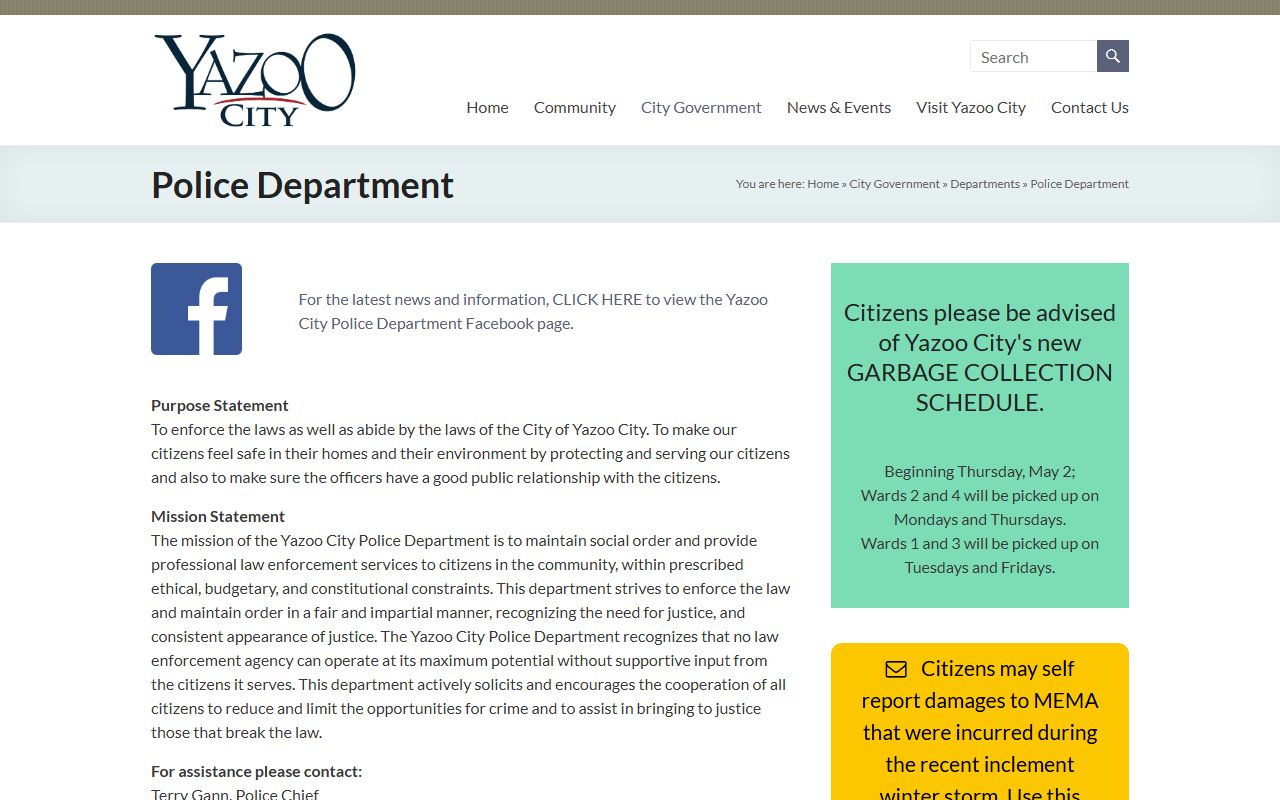
Knowing which agency made the arrest helps a person find the right starting office, because a city police arrest and a county sheriff arrest can route to different courts for the charges that follow.
How to Find Yazoo County Arrest Records and Charges
The charges filed after an arrest show up in the court case file, not in a single mugshot list. For Circuit, County, and Chancery Court cases, the statewide path is Mississippi Electronic Courts and its public access component, PAMEC, which requires a subscriber account and charges per page for documents. Justice Court and Municipal Court do not publish an online case search, so a county misdemeanor or a city charge is confirmed by contacting that court clerk. The booking side of an arrest is checked through the jail roster rather than the court portal.
- Decide which court holds the charge: Circuit Court for felonies, County Court for some transferred felonies, Justice Court for county misdemeanors and initial felony appearances, or Municipal Court for city offenses.
- For a Circuit or County Court case, search PAMEC by the defendant's legal name or by the case number if it is known.
- Open the case and read the charge list to see each offense the prosecutor filed.
- Check each charge for its statute code, its level, and its current status, since a charge can be amended or dropped after it is filed.
For a statewide picture, individual charges roll up into a Mississippi criminal-history record held by law enforcement, separate from any single court file. When a charge cannot be found online, the clerk of the court that handled it can confirm the filing and explain how to request a copy. The Yazoo County Circuit Clerk handles felony and County Court records, while the Municipal Court clerk handles city charges.
How Yazoo County Charges Get Filed After an Arrest
The arrest comes first, at booking. The charge record begins a step later, when a prosecutor or officer files a charging document with the court. In Yazoo County a felony usually starts with an affidavit and initial appearance in Justice Court, where judges hold sessions at the jail three times a week so an arrested person sees a judge within three days. The case then moves to Circuit Court, where the District Attorney seeks a grand jury indictment. The three main charging documents are set out below.
| Complaint | Information | Indictment | |
|---|---|---|---|
| Filed By | Officer / Prosecutor | Prosecutor | Grand Jury |
| Common For | Misdemeanors | Many felonies | Serious felonies |
| Starts | The case | The case | The case |
Felony charges in Yazoo County are prosecuted by the District Attorney for the 21st District, Akillie Malone-Oliver, whose office serves Holmes, Humphreys, and Yazoo counties, with district numbering subject to redistricting. On the other side, a person facing charges who cannot afford a lawyer may be assigned a public defender. The Mississippi Office of State Public Defender keeps the directories of those attorneys through its training division.
The state office that maintains those listings is the Mississippi Office of State Public Defender, which directs people to the right public defender resources for a case.
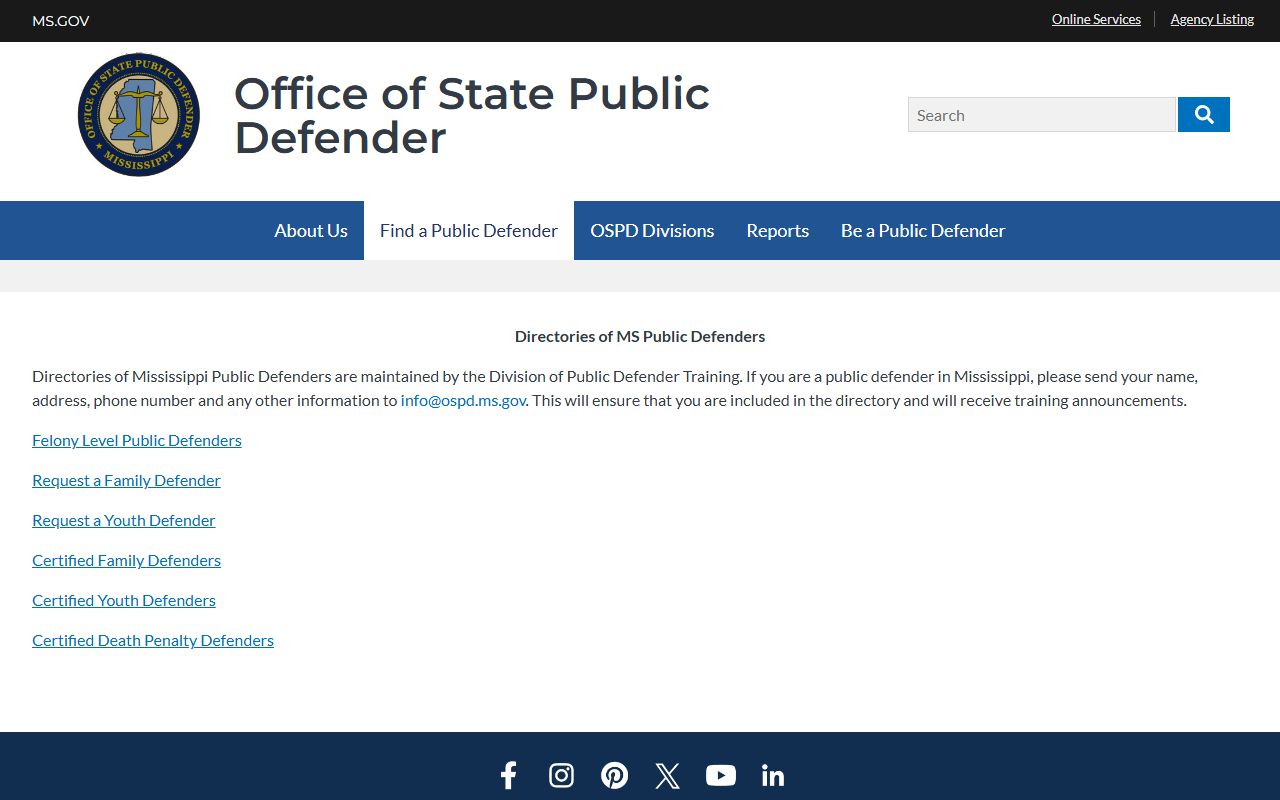
Because appointment and eligibility are decided by the court where a case is pending, public-defender questions go to that court rather than to a central hotline, and the charge record will note when counsel is appointed.
Yazoo County Charge Status and What It Means
A charge is not fixed once it is filed. As a case moves, charges can be amended, reduced, added, dropped, or dismissed, and the case file records each change. Reading the status of every charge, not just the lead offense, is the only way to know where things stand. A single arrest can also produce several charges that end in different ways.
| Status | What It Means |
|---|---|
| Pending | The charge is filed and active, with the case still moving through the court. |
| Amended / Reduced | The charge was changed, often to a lesser offense, by the prosecutor or the court. |
| Dismissed | The charge was dropped by the court, with or without the option to refile. |
| Nolle Prosequi | The prosecutor chose not to pursue the charge, ending it without a conviction. |
Note: A dropped or dismissed charge can still appear in the public file unless the record is later expunged under state law.
Charges vs. Convictions
A charge is an accusation. A conviction is a finding of guilt by plea or by verdict. The difference matters when reading an arrest or charge record, because a record can list charges that were never proven. A person may be arrested and charged, then have the charges reduced, dismissed, or rejected by a jury. Only the disposition line tells whether a charge ended in a conviction.
| Charge | Conviction | |
|---|---|---|
| Stage | Accusation | Verdict or plea |
| Burden of Proof | Probable cause | Beyond reasonable doubt |
| Public Record | Yes | Yes |
Sealed vs. Expunged Records
Some charge records are kept from public view. Sealing limits who can see a record while keeping it for authorized users, and expunction removes an eligible record from public access. Mississippi Code Section 99-19-71 is the key expunction statute, and it reaches cases where an arrest was made but the charge was dismissed, dropped, had no disposition, or ended in acquittal, along with certain misdemeanor and one eligible felony conviction. The petition is filed in the court where the charge originated.
| Sealed | Expunged | |
|---|---|---|
| Visibility | Hidden from public | Removed from public access |
| Law Enforcement | Limited access | Very limited |
| Eligibility | Youth records and court-ordered restrictions under Miss. Code § 43-21-255 and § 43-21-261 | Eligible arrests and charges under Miss. Code § 99-19-71, filed in the court of origin |
Yazoo County Charge Codes and Severity Levels
Each charge is tied to a Mississippi statute, and that citation tells a reader exactly what was filed. The statute also sets the level of the offense. Felonies are the most serious and carry the longest possible penalties, misdemeanors are lower-level offenses, and minor violations fall below those. In Yazoo County, where a charge is heard depends on its level, so a felony is prosecuted in Circuit Court while a misdemeanor stays in Justice Court or Municipal Court.
One arrest can produce several separate charges, each with its own code and its own outcome. A person booked on a single incident may face a felony count, a related misdemeanor, and a traffic charge, and the file tracks all of them. Matching each charge to its statute is the most reliable way to understand the severity of what was filed rather than relying on a short label.
Statewide Charge and Criminal History Lookups
A single court file shows one case, but charges also roll up into a statewide criminal history held by Mississippi law enforcement. That statewide record is not a casual public search, and access is limited by law. For most people, the practical route to charge information is the court case file through PAMEC or a clerk, or a regulated background check run by a licensed agency.
Public access to court charge records follows the Mississippi Public Records Act, which opens the records of public bodies unless a specific law exempts them. A records request goes to the office that holds the record, and sealed, expunged, and juvenile matters stay out of public results. Even an open charge record may be released with Social Security numbers and other protected identifiers removed.
Background Check Considerations
Arrest and charge records are often pulled for a background check, but a casual lookup is not the same as a regulated report. A check run for hiring, housing, or credit must follow the Fair Credit Reporting Act and use a licensed consumer reporting agency. A public charge search through a court portal does not meet that standard and should not be used to make those decisions.
Important: This site is not a consumer reporting agency under the Fair Credit Reporting Act, and its information may not be used for hiring, housing, credit, or other FCRA-regulated purposes.
Restricted Charge Records in Yazoo County
Not every charge record is open. Juvenile charges in Youth Court are confidential under Mississippi law and are not searched like adult cases. Sealed and expunged charges are withheld, and a court may restrict a charge tied to an active investigation. Dismissed charges can sometimes be removed from public view once an expunction order is signed, though they may appear until then.
When a charge record cannot be found online, the next step is the clerk of the court that handles the case or the agency that made the arrest. For the booking side and current custody, the jail roster is the right tool, while the full case file and final outcome appear in the Yazoo County criminal court records. Matching the charge to the right court and office keeps the search on track.